We use only raw milk from certified farms in the area of origin, strictly controlled to ensure its excellence and preserve its taste.
It is precisely through the processing of milk that the journey of a PDO unique in the world begins.
Skimming
The raw milk must be produced in the geographical area set in the Product Specifications. It is partially skimmed by natural surface skimming.
Copper Cauldrons
1.000 litres of this partially skimmed milk is then placed inside traditional bell-shaped copper cooking cauldrons (or vats, Each cauldron produces two wheels of cheese, called “twin wheels”.
Whey
Then the whey produced the day before is added. Full of lactic acid bacteria, whey is the perfect way to trigger the transformation of milk into cheese.
It is the precise balance between temperature and resting times that governs the transformation process.
Rennet
Once the whey has been added, the milk is brought to a temperature of 31-33°C (88-91° F) and the calf rennet is added.
Breaking of the curd
The curd is then broken with a giant whisk (spino) into pieces which are as small as grains of rice
Heating
The broken curd is then heated to a maximum temperature of 56° C (136° F). Once this temperature is reached, the cooking is completed, and the curd granules begin to settle at the bottom of the copper cauldron.
Resting
The curd granules are left to rest in the copper cauldron, immersed in the whey, for a maximum of 70 minutes from the end of the heating phase, so that they aggregate, to form a compact mass.
From the expert hands of the cheesemakers and the linen cloths we witness the birth of the shape.
Lifting
Using a sort of a wooden shovel (pala) and a linen cloth (schiavino), the curd mass is raised from the bottom of the cauldron and cut into two equal parts, in order to create two twin wheels.
Extraction
Each of the two wheels are removed from the copper cauldron, wrapped in linen cloths and placed on a shelf – the “spersola”.
First molding
Each wheel is placed into a special mould, the fascera, made of suitable plastic material. A heavy object of the same material is then placed on top of the cheese to place pressure.
Each wheel receives its unique identity and traceability through the seal of excellence.
Marks of origin
After about 12 hours, a piece of plastic (fascera) engraved with the Marks of Origins is inserted.
Casein Plate
Then a casein plate, with a specific ID code is placed on the top face of the wheel, this is crucial when identifying the traceability of each wheel.
Salting
Two days later, the process of salting (salatura) starts: the cheese wheels are soaked in brine, a solution of water and salt. This step can take from 12 to 25 days, depending on the saline solution and the size of the wheel.
Drying
Once the salting is finished, the wheels are taken into a “hot room” (camera calda) where they will dry for a few hours.
towards maturation
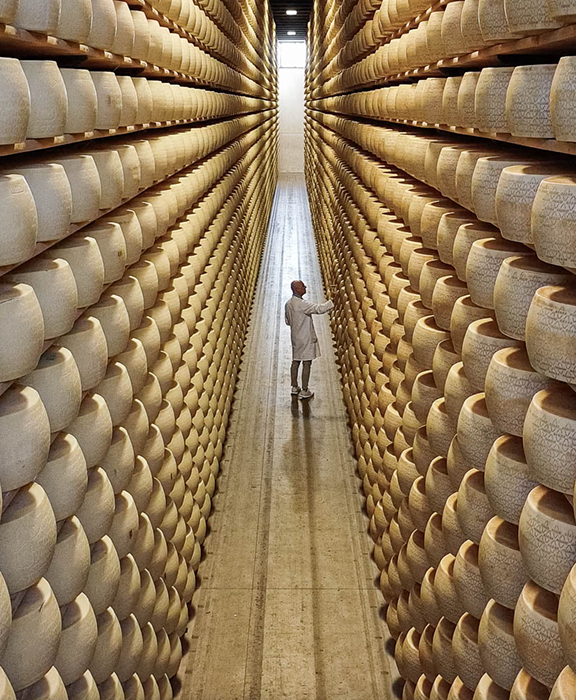
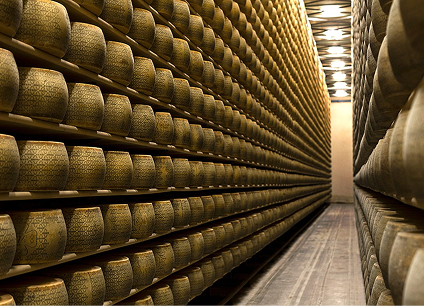
Once the cheese is processed, all that remains is to transfer the wheels to the maturing warehouse, where they will remain for a minimum of nine months. Here, the flavor is refined and the distinctive Grana Padano branding is applied.