
We use only raw milk from certified farms in the area of origin, strictly controlled to ensure its excellence and preserve its taste.
It is precisely through the processing of milk that the journey of a PDO unique in the world begins.
Skimming
The milk, obtained from no more than two milkings per day or from free-access milking systems, is left to rest. During this time, partial skimming occurs through natural separation: the cream rises to the surface, leaving the milk ready for processing.
Starter whey
The milk, obtained from no more than two milkings per day or from free-access milking systems, is left to rest. During this time, partial skimming occurs through natural separation: the cream rises to the surface, leaving the milk ready for processing.
The vat
The milk, obtained from no more than two milkings per day or from free-access milking systems, is left to rest. During this time, partial skimming occurs through natural separation: the cream rises to the surface, leaving the milk ready for processing.
It is the precise balance between temperature and resting times that governs the transformation process.
The rennet
The inoculated milk is brought to a temperature of 31–33°C and calf rennet is added.
I spin it
The inoculated milk is brought to a temperature of 31–33°C and calf rennet is added.
Cooking
The inoculated milk is brought to a temperature of 31–33°C and calf rennet is added.
Rest
The inoculated milk is brought to a temperature of 31–33°C and calf rennet is added.
From the expert hands of the cheesemakers and the linen cloths we witness the birth of the shape.
The “twin” forms
Using a wooden shovel and a “schiavino”, the cheese mass is recovered from the bottom of the cauldron and cut into two equal parts, so as to create the two “twin forms”.
The extraction
Using a wooden shovel and a “schiavino”, the cheese mass is recovered from the bottom of the cauldron and cut into two equal parts, so as to create the two “twin forms”.
The sling
Using a wooden shovel and a “schiavino”, the cheese mass is recovered from the bottom of the cauldron and cut into two equal parts, so as to create the two “twin forms”.
Each wheel receives its unique identity and traceability through the seal of excellence.
The branding
Approximately 12 hours after being placed in the mould, another band of suitable plastic material with the marks of origin in relief is inserted between the band and the lateral edge of the mould – the edge.
The casein plaque
Approximately 12 hours after being placed in the mould, another band of suitable plastic material with the marks of origin in relief is inserted between the band and the lateral edge of the mould – the edge.
Salting
Approximately 12 hours after being placed in the mould, another band of suitable plastic material with the marks of origin in relief is inserted between the band and the lateral edge of the mould – the edge.
The warm room
Approximately 12 hours after being placed in the mould, another band of suitable plastic material with the marks of origin in relief is inserted between the band and the lateral edge of the mould – the edge.
towards maturation
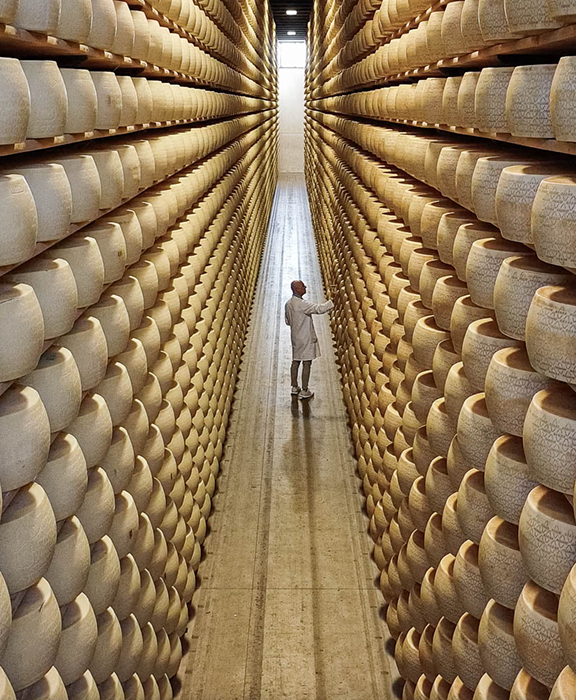
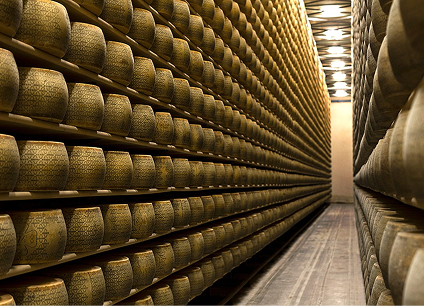
Once the cheese is processed, all that remains is to transfer the wheels to the maturing warehouse, where they will remain for a minimum of nine months. Here, the flavor is refined and the distinctive Grana Padano branding is applied.